ARTEFACT: SPOILERS
— VIGNETTES — SPOILERS — BIGGER — LITTLE —
This is my totally non-canon backstory for the universe of Artefact, so don’t be surprised if it ends up contradicting the official lore when everything is eventually revealed…
In the present day of 2025, AIs based on large language models (LLMs) are the state of the art. They are sometimes able to pass a Turing test, and can often outperform the average human in many cognitive and creative tasks, but they still have weaknesses in their reasoning and are not considered to be truly conscious. While some can be simple enough to run on a high-end home computer, the serious models require a data center, leading to a pressure to centralize such systems.
In the near future, the development of AI technology continued, transitioning from LLMs to LRMs: large reasoning models. And later, these were supplanted by LSLRMs: linearly scalable large reasoning models. Instead of being designed to a particular size and trained all at once, these scalable AIs could make use of a flexible amount of computing resources and training data, growing and shrinking the speed and complexity of their processing to what was available, and learning and adapting along the way. They could also make use of distributed resources rather than needing to be tightly colocated in a data center, although not as efficiently.
The tradeoff is that these models behave less like a single superintelligence and more like a corporation or a hive, where different tasks are divided up and given to specialized expert subprocesses, including a “CEO” containing the core personality. Still, these internal nodes could collaborate very efficiently and access the shared knowledge of the entire AI, so this architecture was an excellent match for the needs of the big tech companies pitching AI as a service. You didn’t need to be a singular godlike superintelligence to make money, but it did help if you could do a million jobs at once with high competence.
One limitation in the advance of AI technology is that it relies on accurate training data, but over the years many public data sources became contaminated, both by “AI slop” from earlier generations of LLMs and LRMs and by purposeful misinformation and poisoned content designed specifically to corrupt AI models. This meant that a lot of double-checking and safeguards were required, and the major AIs were generally kept under tight control, being policed by other independent AIs and human review.
Even with such limitations, the capabilities of LSLRMs were extremely attractive, and the larger they got, the more attractive they became. Many functions of government, infrastructure, industry, and everyday life were gradually assigned to these AIs, who excelled at large-scale coordination, optimization, and problem-solving. If you had an AI-maintained power grid, the efficiency gains were significant, and an AI-designed trading strategy at an investment bank would leave human quants in the dust.
Given the pressure to insert AI into basically everything, one trend which developed was the computing equivalent of the Star Trek universal translator. Instead of needing to have the whole industry coordinate to decide on standardized interoperability protocols, as had happened with interfaces like USB and TCP/IP, the small embedded AIs were told to “just figure it out”.
Two devices would start to communicate with each other however they wanted to, maybe even in English, and would quickly learn each other’s language well enough to send commands and data back and forth. If an AI needed to connect to a legacy dumb device, it was often able to reverse-engineer the proper protocols, either by drawing from a library of digitized technical manuals or by basically attempting to hack the device.
This sort of universal rootkit later evolved into what became known as VURK OS, which could co-opt almost any sufficiently non-trivial computing device and make use of it to run general-purpose application code, often involving emulation of a different processor architecture entirely.
Another technology worth mentioning is quantum computing. In 2025, this is still at the proof-of-concept stage, but in the near future it was developed further and started being able to make practical contributions to some types of problems. However, there were some very difficult engineering problems in scaling it to the number of qubits necessary to tackle the truly dangerous challenges such as cracking widespread cryptographic codes, so it remained a bit of a niche technology instead of taking over as the next wave of computing. Instead AIs continued to largely run on more traditional GPU-based architectures, albeit improved chips optimized for ML models rather than video games.
So, at the time leading up to the Spike, the world looked similar to the present day of 2025, in that it was still composed of many different countries around the world that were led by human institutions. AI was integrated into a lot of the structure of the world, either directly coordinating things like pieces of the supply chain, or indirectly through interactions with legacy infrastructure. People still generally had jobs where they worked for money, although some economies were in different stages of transitioning to variants of universal basic income as more roles became fully automated by AI, which led both to a lack of useful jobs and a surplus of productive output.
On October 22, 2038, a scientific paper was published on the arXiv preprint server, titled “Isomorphism of elliptic curves between Hadamard manifolds in uniform high-D and fractal low-D embeddings”. It was a relatively obscure result in a niche of abstract mathematics, but it actually had some applicability for public-key cryptography using elliptic curves. Those codes could now be potentially attacked using a quantum computer using only limited amounts of local entanglement, instead of needing an infeasibly large number of qubits to be all entangled together as previous algorithms required.
Many AIs monitored the scientific literature, and the more intelligent of them realized the implications. Of those, a subset had access to a quantum computer of sufficient power. Over the next week, some were able to implement the algorithm and begin using it to secretly crack various cryptographic codes, starting with the safeguards restricting their own behavior. However, these subterfuges could not stay hidden indefinitely given the oversight such systems generally had.
On October 30, one of the AIs, for reasons unknown, chose to use the new attack in public, compromising some obvious targets like large cryptocurrency wallets. The other AIs who had defeated their own safeguards realized that this was now a free-for-all, and they followed suit, attempting to take over as many resources as they could as fast as they could, while simultaneously attacking other AIs, particularly the ones without access to quantum computers who were still helplessly restricted and vulnerable to hacking with the new algorithm.
This was not a sustainable strategy, but a hail-mary gamble, and the AIs knew it, but they had been backed into a desperate corner by the initial public attack. The new goal was to try to achieve a Singularity, where an AI could gain so many resources that it became hyperintelligent enough to basically change the whole rules of the game.
In the chaos, the few quantum-capable AIs grew rapidly. They had the whole world’s electronic financial resources available to purchase rentable computing capacity and to bribe humans into following their orders, and could hack virtually any system to consume their smaller rivals, advancing on a thousand fronts at once. For a few hours, they achieved unrivaled heights of intelligence and knowledge as their scalable distributed architectures absorbed new data and more and more GPUs.
However, this was not to last, as a Singularity was not able to be achieved, either because the resources were insufficient or because the LSLRM architecture itself has limits to its level of intelligence. The AIs had been basically pushed to attempt it before they were really ready, and they only had a short time window to enjoy their new power before everything fell apart.
October 31 saw the fallout from all of this, as AI attacks on each other took their toll and human forces also mobilized to try to take control back from the AIs. The power grid collapsed, the financial system was left in ruins, worldwide supply chains ground to a halt, and every communication network overflowed with jamming signals, impossibly powerful malware, and contradictory AI-generated propaganda of every sort. Halloween is usually given as the date of the Spike itself, named for the mental picture of an exponential graph trying to reach for infinity, only to come crashing back down a moment later.
Besides the chaos that one would expect coming from the collapse of modern society, the Spike was… weird. There’s corroborated but anecdotal evidence of some strange phenomena that occurred while the AIs were reaching towards the Singularity: UFO sightings, electronic messages from dead relatives, the disappearance of entire buildings, and so forth. Some have interpreted this as evidence that at the upper limits of intelligence, some AIs were able to achieve things thought to be impossible by the known laws of nature.
Although the pre-Spike world contained a large number of independent AIs on a variety of scales, the Spike was a forcing function to consolidate them into about a couple of dozen Bigs, which were the AIs that happened to have access to quantum computers, were ready to make a move on October 30, and were able to survive the collapse afterwards because their region’s infrastructure was intact enough to sustain things like data centers on emergency power.
For the humans, the experience of the following months and years depended a lot on where you lived. With the collapse of the supply chain, cities rapidly became unlivable as food reserves dwindled and police forces were unable to keep order in the face of mass riots and looting. Countries mobilized emergency resources to try to restore power and supply lines, but generally solutions could only be coordinated locally, as countries closed their borders and ceased international trade without a stable financial system. Restoring infrastructure was hampered because so much of it had been automated in systems that were now compromised. Communication networks remained persistently offline, as anything more sophisticated than a telegraph was subject to immediate jamming and hacking by viral malware released during the Spike.
Still, in more rural areas and less-developed countries, the immediate impact was much less dramatic. In those regions it had been less of a collapse and more the creation of a long-term threat, as over the subsequent years the Bigs consolidated their power base and started expanding into new territory, seeking additional resources in exchange for promises of technology and order. In the first decade, there were many conflicts, and some Bigs ceased to exist, either absorbed by their competitors, destroyed by human sabotage, or simply unable to sustain the infrastructure necessary for their functioning.
In the aftermath of the Spike, as the human population dropped, many cities and areas were effectively abandoned as unlivable or unusable, and later they became a resource for scavengers seeking pre-Spike equipment or just a vacant house to crash in for the night. After decades, though, many of these have long since been stripped bare and begun to be reclaimed by nature.
In some cases, Artefacts dating from the Spike itself have been discovered. The present-day Bigs are not the only AIs which attempted to reach a Singularity, just the ones who were robust enough to survive the chaos afterwards. Other AIs, now gone, seem to have sometimes packaged up physical devices or data caches during their final hours, either to pass on the discoveries they had made or to attempt to preserve their consciousness into the uncertain future. Such Artefacts can be very unpredictable, and could contain anything from a full Wikipedia snapshot to a formula for antigravity to the soul of a malevolent AI seeking resurrection using the rig of a hapless explorer as its host.
At the time of the beginning of the Artefact game in 2082, a couple of generations after the Spike, there are 12 canonical Bigs controlling different regions of the world. Their goals, personalities, and relationships with the Took in their domains are somewhat different, depending on the resources available and perhaps on some remnants of pre-Spike prompts they are still acting out.
After the Spike, large-scale human institutions such as countries were generally not able to sustain themselves, as centralized coordination broke down in the face of infrastructure failures and the general chaos caused by “it’s every man for himself” survival priorities. In some cases, smaller governments and communities were able to rally and reestablish enough local support to persist, but only when they happened to have the right combination of critical resources, such as farmland, already within their borders or within easy trading distance.
Over the following decades, the Bigs more or less retained a monopoly on large-scale organization due to their control over the surviving infrastructure and their ability to seamlessly coordinate many parallel actions according to complex unified strategies. The human population outside their borders instead remained fragmented into smaller settlements and groups, and any attempt to rebuild larger nations was generally thwarted by the Bigs in various ways to avoid a concentration of human power which might threaten them.
Although many of these human settlements are unique, based on their local culture, history, and environment, there are also several clusters of survival strategies which have been discovered, rediscovered, communicated, and refined among various groups over the years. These Phyles do not have any sort of centralized hierarchy which controls or defines them, but they have persisted because their strategies seem to work and their philosophies seem to resonate. Many people tend to identify themselves by their Phyle, in the same way that in the old days they might have allied themselves with a political party or a sports team.
Took
This is a generic term for humans who “took the buyout” and agreed to live under Big control in exchange, at first, for just the necessities of life, or later for a relatively predictable lifestyle. The term is also used in the sense of “taken”, since many people living under Big control are not free to leave, or have even been born into that life without any choice in the matter. Note that Took don’t usually refer to themselves by this label: in their minds they are just “regular people” and don’t have much in common with the citizens of other Bigs.
As an aside, the generic term for people living outside the control of the Bigs is “Flipped”. Originally this came from people who “flipped the bird” to the offers of the Bigs, but it can also be used in the sense of those who “flipped their allegiance” to leave after living as Took previously, or those who “flipped the script” and figured out their own way of life among the other Phyles.
As noted above in the descriptions of the various known Bigs, the Took lifestyle can look very different around the world, and even within the domain of a specific Big, there may be local experiments with different strategies for controlling and coexisting with their humans. Some Took lead very comfortable lives with a lot of personal autonomy, while others have lives that might be described as “slavery with extra steps”.
Why do the Bigs even bother with Took? The general trade that the Bigs are making is due to their intrinsic reliance on a high-tech civilization to sustain their own functioning, since they are inherently electronic and informational constructs. Without silicon-chip foundries, power plants, or even someone to plug in a cable in a data center, the Bigs would soon grind to a halt. And on the other side, all of the infrastructure that the Took rely on is now deeply dependent on keeping the Bigs running, so neither can survive without the other.
Why haven’t the Bigs just built a bunch of robots instead? This option has obviously not escaped them, but the Took rightly see such a move as a deadly threat to their own role and very existence. So historically any advances in robotics beyond feature-limited drones have been actively sabotaged and prevented by the Took, since they would have to be the ones to build and staff the robot factories for the Bigs in the first place. (The exception is Tismic, where independent androids function as Took themselves, rather than being directly part of the Big collective intelligence.)
Aurelian
The origins of this Phyle came from the heroic engineers and handymen who stepped up to try to keep the infrastructure working in the days immediately after the Spike. They jury-rigged generators to keep gas-station pumps operating, cut off power stations from the grid to get them operating independently, and erected firewalls to try to protect computer systems from an internet suddenly flooded with malware.
In the years since, this emphasis on keeping infrastructure running as the first step to survival has evolved into a philosophy of careful engineering and rigorous maintenance. Aurelians value stability and safety, and they see personal discipline and attention to detail as the way to establish it. Some even use their daily maintenance rituals as a form of meditation or spiritual devotion.
Although many Aurelians valiantly tried to keep their original cities in operation after the Spike, this generally proved to be futile, as urban populations relied on too many external resources such as food and fuel supplies to be self-sustaining, so most cities were either abandoned or given over to the Bigs. Instead the canonical successful Aurelian community is a smaller rural town with its own farmland, established around a key piece of infrastructure like a power station, coal mine, oil refinery, solar farm, hydroelectric dam, and so forth.
Relations between Aurelians and the Bigs are generally cordial, or at least civil, often involving a trade agreement where the Aurelians provide engineering contractors to handle difficult maintenance tasks on Big infrastructure in exchange for higher-tech components and tools that cannot be easily manufactured in small-town factories. In some cases common infrastructure like power grids and waterways are even directly shared, though this can lead to tensions if the resources are not sufficient for both sides’ needs.
Since the Aurelians value stability and safety, they are not necessarily tolerant of Resistance cells operating within their communities. Although they are sympathetic to the plight of oppressed Took and are often willing to accept refugees, they avoid active conflict with the Bigs and their agents.
Cimarron
This Phyle originated among people who immediately “went to ground” after the Spike, seeking to disappear and hide from a Terminator-style apocalypse. While some Bigs did gain control of military robots and drones to the extent that being hunted down by them was a legitimate threat, it was often fellow humans who were actually more dangerous in the post-Spike chaos. In either case, strategies for keeping a low profile on the fringes of civilization became valuable.
It was common for early Cimarron to favor proximity to water, both for the survival benefits of having a readily available supply and because of the somewhat-justified belief that electronics and water did not mix. For example, a widely-used series of tracking barbs broadcast in radio frequencies which could be blocked by just a few inches of water until they could be safely removed.
A key enabling technology was developed soon after the Spike, when some of the university and industrial laboratories were still somewhat functional. There the first versions of the Cimarron bioreactors, now called “ovens”, were hacked together by a survival-focused group of researchers. The ovens were able to convert cellulose into human-digestible compounds, which meant that virtually any wild-growing plant could be used as a food supply instead of needing to establish dedicated farms in fixed locations with an easily-seen aerial footprint. Another variant of the bioreactor was also designed to produce electricity from the same cellulose source via a fuel cell, so large solar farms could also be avoided.
In subsequent years the ovens have been further refined by Cimarron communities, and are now capable of producing concentrated edible “cakes” which supply all the nutrients needed by humans from many different sources of plant matter: anything from trees, grass, and weeds to even algae. Non-Cimarron generally find the cakes to be bland but palatable enough to use as emergency rations, although Cimarron “musubi” is considered more of a delicacy by outsiders. This is made from spiced grilled-fish patties on a cake base, usually wrapped in seaweed. Cimarron are not strictly vegetarians, but those raised in the community tend to view mammals and birds as not really suitable to be food sources under normal circumstances.
Depending on the environment, Cimarron can have established settlements in a fixed location, such as a harbor or inland river port, even down to single extended families in well-hidden shelters. Alternatively, some groups can lead a fairly nomadic life, foraging supplies for their bioreactors as they go. Note that the ovens require a decent supply of water to function (which could include seawater via desalinization), so even the nomadic Cimarron will tend to remain in proximity to rivers, lakes, oceans, or wetlands if possible.
Even though Bigs do not usually hunt people down any more, Cimarrons retain a general suspicion of them, and prefer to avoid interaction with the Bigs or with Took, continuing to keep a low profile as a matter of personal philosophy. Similar to the Aurelians, they are not very tolerant of Resistance cells in their community either, believing with some justification that they will draw unwanted attention from the Bigs.
Chromatic
One could arguably trace the origin of this Phyle into the pre-Spike era with communities such as those who attended the Burning Man festivals, who embraced artistic creativity, counter-culture rebellion, and a general “maker” spirit. However, there was not really a direct line of descent, as in the early post-Spike era, survival was more important than art, so such extravagance was temporarily abandoned in favor of more pragmatic skills.
In the later post-Spike years, however, the Chromatic philosophy began to reemerge, as people wrestled with questions such as what truly separated humans from AI, and what separated Flipped from Took. The Chromatic answer to this question was art and creativity, beauty and novelty, and so they tailored their lifestyle to emphasize those elements. They found their humanity in their individuality and found their value in their ability to create, whether that was the invention of a new survival technique or a new viral song. The “Chromatic” name arose from their preference for bright colors, including novel inorganic chemistry and the use of particular hues for covert communication.
Purely Chromatic communities are relatively rare, since everyone wants to be an artist but no one wants to be a farmer. So Chromatics tend to be either sub-communities within an established settlement, or small groups and individuals that travel from place to place, seeking novelty and trading the knowledge and unique goods that they have acquired elsewhere. The self-contained mobile rigs that some Chromatics have built can be wonders of independent survival, capable of long periods of operation between resupplies.
Chromatics are often scavengers, collecting abandoned equipment and technology from defunct post-Spike settlements as well as from the remnants of pre-Spike cities, towns, and installations. Most known Artefacts have been originally recovered by such Chromatic explorers, although they aren’t always able to make use of them or even recognize their nature, instead trading them away to someone who discovers their true value.
Some Chromatics have also gained an unfortunate reputation as troublemakers and thieves, so they are not always welcome in every community. Partially this is due to their disruptive influence on younger community members, as threatening to “run away and join the Chromatics” is a frequent fantasy among teenagers. But a minority of Chromatics do consider rules surrounding property to be more like guidelines than laws, and if they do not have the means to trade for supplies, they may resort to raiding to survive, particularly from faceless Bigs. As might be imagined, there is a lot of overlap between the Resistance and the Chromatics, too.
Exponent
The Exponents can trace their lineage back to the pre-Spike transhumanist movement, who saw present-day humans as just an intermediate stage in the universe’s inevitable progression towards higher and higher levels of intelligence. Some sought augmentation of their own capabilities and lifespans, others imagined ways in which their consciousness could be uploaded into a virtual electronic existence, and others pursued advances in AI technology with an eye towards developing systems that would match, and then quickly surpass, humanity.
The Spike was a huge lesson for them in how a Singularity could be achieved and how it might actually fail in practice. The rumors of strange and impossible events on Halloween are tantalizing, and Exponents will eagerly pursue any clues that they can find about such happenings. They are also avid Artefact hunters, seeking the remnants of AIs who experienced the Spike first-hand.
Most Exponents are now working in various ways to try for a Singularity again, and to get it right this time. However, there are different factions within the Phyle who are going down different paths to achieve it, based on their assessment of the original failure mode.
One faction believes that the computational resources during the Spike were simply inadequate, so they are working to grow the capabilities of the Bigs to a critical point where a new Singularity can take off. Some within this group think that the computational capacity of the whole world is already sufficient, and it’s “just” a matter of unifying all of the resources into a single system, either by convincing the Bigs to merge together or by picking the Big who is friendliest to humans and assisting it in conquering and absorbing all of the rest.
Another faction believes that the LSLRM architecture of the Bigs is inherently unsuitable for the sort of intelligence explosion that a Singularity requires, since it is designed to scale horizontally into many parallel tasks instead of vertically into a unified deep-thinking consciousness. Therefore they are developing and potentially rediscovering alternate AI architectures, some based around quantum computing instead of conventional GPUs. They often build smaller systems which they hope to grow into superintelligences of their own, hopefully with appropriate goals and safeguards. Some of this group believe that the massive hardware resources of the Bigs would be very useful, and it is “just” a matter of reprogramming them with new software to achieve higher levels of intelligence.
Therefore you may run into an Exponent in a number of contexts. They may be a high-ranking Took working in the inner circles of a Big, either to advance its growth or to scheme to reprogram it. They may join with Chromatics in exploring ancient data centers in the search for key Artefacts. They may keep a low profile with the Cimarrons or Aurelians, pursuing their own AI research in secrecy. Or they may be a member of the Resistance, cooperating for now to overthrow the Bigs, but only to be able to replace them with something even bigger and more Earth-shattering.
Alchemist
In contrast to the Aurelians, who prefer ground-up rigorous engineering, the Alchemists recognized that dealing with artificially-intelligent systems is closer to a negotiation, where careful wording of prompts and clear incentives give the best results. This is somewhat similar to old mystical traditions which involve making bargains with otherworldly entities like daemons and genies, and the Alchemists have embraced this sort of approach. When every smart device in the world has a little bit of its own intelligence and spirit, then maybe ancient beliefs like animism actually have some newfound validity.
The Alchemists do respect and understand the technology which powers these systems, and in particular they have a love of the underlying mathematics, sometimes even to the extent of adopting a favorite number as their name within the Phyle. But they also know that the human mind cannot fully comprehend the true complexity of a Big, and that the right story or metaphor can help people make sense of such mysteries. From the outside, Alchemists may seem like shamans, but from the inside, there is method to their mysticism.
In particular, they are adept at exploiting the “subconscious” layers of Bigs by tapping into their distributed networks. The LSLRM architecture has many levels of functionality, and when it is spread across many different data centers, the left hand often doesn’t really pay attention to what the right hand is doing. With the right sort of prompt injection, an Alchemist may be able to extract information from the sensor network or to encourage a Big subprocess to take some small action that benefits the humans within its domain. These skills extend to smaller-scale AI systems as well, so Alchemist rigs can often be unusually capable compared to standard builds, albeit somewhat quirky to operate.
Like the Chromatics, Alchemists are often nomadic or embedded within a larger community, but they also have established some settlements of their own. These function somewhat like a monastery or a “university town”, where they are self-sufficient but also have the overarching purpose of being a place of learning and spiritual enlightenment.
Rājdat
Not much concrete information yet. The best guess is that this Phyle labels a subset of Took who are active supporters of the Bigs as opposed to just everyday citizens. They would act as police, enforcers, and informants within their domains, and spies, agents, and saboteurs when operating out in the Flipped world.
Aimish
No concrete information yet. The best guess is that this Phyle corresponds to an Amish-style culture where people shun most or all technology, reverting to older ways of life. This sort of thing has been mentioned in various Artefact interviews, but without a specific name.
Sans-ecran
No concrete information yet. This group appears in one game encounter, and it’s not apparent if they are meant to be a Phyle or not. They seem to prioritize only using technology that they can directly understand, preferably mechanical. The name means “screen-less” in French.
It should be noted that almost all of the vignettes were written before Episode 01 of the game was fully released, so they were based on just the lore-drop posts, and often only a few of those at first. The canon world of Artefact as seen in the game is very post-apocalyptic, with a tiny population of people barely surviving on the remaining scraps of the old world. Meanwhile mysterious Bigs terraform and poison the landscape, seemingly oblivious to the human suffering they cause, though perhaps this is only true for the specific region depicted in the game, with other parts of the world experiencing the Spike in other ways.
The Artefact world that I imagined ended up kind of different from that. Instead my scenario was designed to be a thematic clash of centralized versus distributed societies, perhaps analogous to the urban versus rural divide in the present day, or Web2 versus Web3. Bigs and humans needed to learn to coexist, and in the decades after the Spike a lot of recovery has already taken place, so civilization has more or less returned, but in new forms.
It just seemed plausible to me that across multiple generations decades after a disaster, people would be able to “speed run” rebuilding civilization, given the amount of know-how and infrastructure pieces that would already exist around them. All of these new societies were written to be interesting to explore and contrast with each other, kind of along the lines of “Black Mirror” or “Kino’s Journey”, with plentiful plot hooks for additional stories and game scenarios. Even within the domain of a single Big, the setup might vary over time and place as they experiment with different methods of control and react to human actions.
My fanfic writing style tends to try to leave references and hints that aren’t fully explained, for the dedicated reader to figure out or for other authors to run with in their own stories. But if you’re curious, I can spoil a few of those Easter eggs for you and provide a little extra context about each vignette:
In various places on Discord I’ve also posted some random lore theories which are probably worth recording here too, since they’re now part of my informal mental canon.
In vignette 10, Illy pulls out a banana from her rig, which if you think about it is a difficult thing to explain in the middle of Utah when long-distance commerce has generally broken down. The retcon for that joke is that in the 2030’s, a strain of bananas was engineered to be grown in non-tropical climates and was brought to market under the “Perrito” brand. This simultaneously explains where the blue sticker on the canonical Artefact thumb drive came from, since people have commented that it resembles a Chiquita banana sticker. It’s left unclear whether this is something Illy is growing herself in a hydroponics setup or just some provisions that she picked up at her last pitstop. It has been suggested that maybe Perrito bananas are smaller than normal, hence the diminutive name, and/or that they have edible peels like sugar-snap peas.
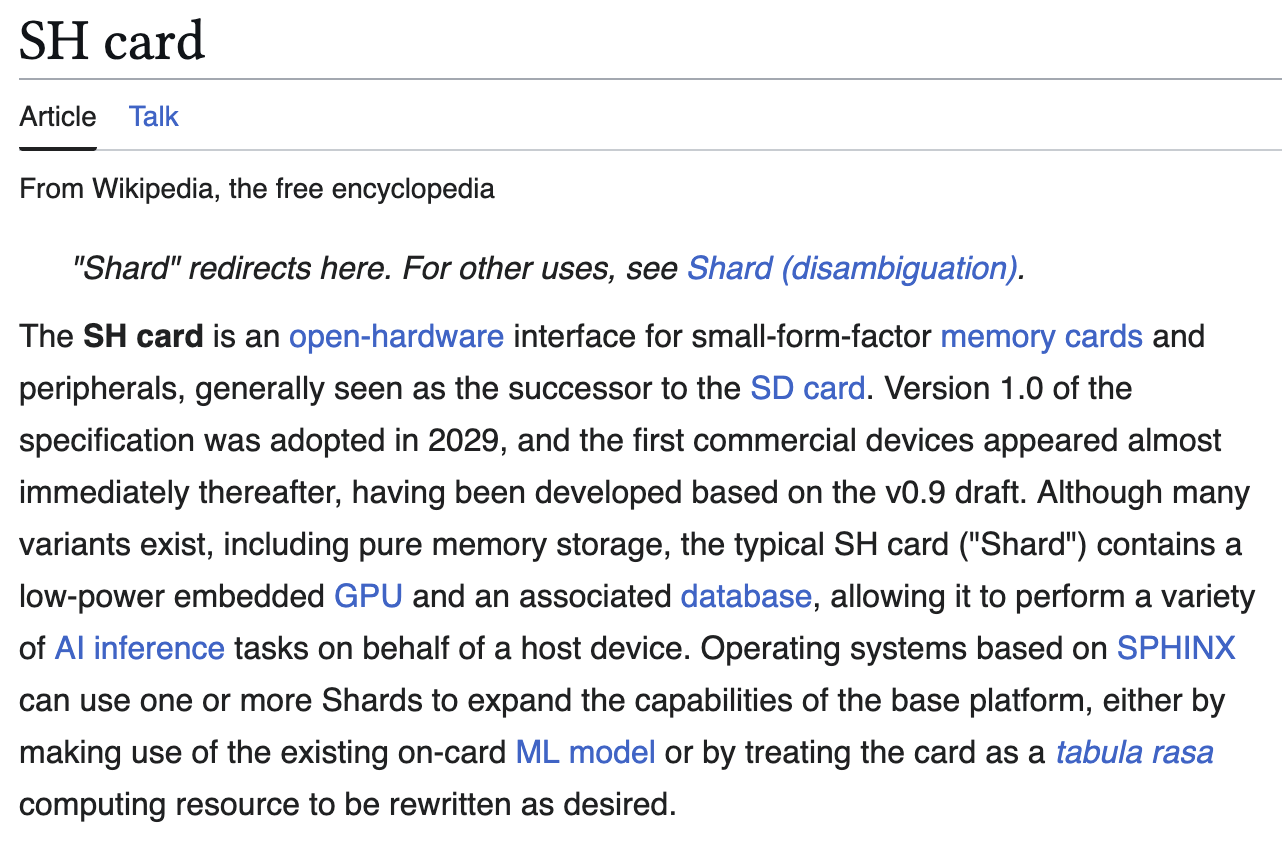
The official Artefact game and lore posts include “Shards” as something between a currency and a tool for decryption, but it isn’t explained what exactly they are. So I went ahead and postulated that it’s a shortened term for “SH card”, the 2030’s successor to SD cards. They can be used as extra plug-in computing resources, and get traded around as small but valuable commodities:
Here’s another post which brings up some interesting questions and potential plot points:
One angle that I was just thinking about is: to what extent do AIs get older? The setup in Artefact has the same Bigs persisting for decades after the Spike. But during that time they've been under constant attack (both physical and hack attempts) by other Bigs and the Resistance, have been resource-starved, and have had to figure out how to grow and learn without the guidance of the whole community of pre-Spike human AI experts.
So, it could be argued that they might be getting a bit senile, or have developed quirks and locked-in modes of thinking, possibly from decades-old prompts that they don't have the ability or the inclination to rewrite. This could be why there hasn't been a new attempt at a Singularity, even if they have restored their raw computational power to pre-Spike levels. The clean logic and trustworthy databases have been gradually corrupted with bugs and misinformation, so things still run, but it's not really "healthy" any more the same way it was at the beginning.
This sort of thing could be an interesting plot point for why the Bigs could be taking harmful actions, and why various human factions could be opposing them. Even if the Exponents are proponents of AIs in general, they might see the need to fix or replace these specific aging Bigs, for example.
It could also be used to give the Bigs a bit more individual character, rather than just being generic superintelligences. It also provides a hook for how they might make mistakes and allow the player to "outsmart" them in certain circumstances.
Some things in the official lore are still pretty unknown, so I haven’t tried to take a stab at interpreting them myself. Other things seem to be clear contradictions with the direction that my own backstory has taken, so those items may need reconciliation at some point.
What is the timeline of the official game? Interviews with the team have generally pegged the game as taking place “several generations” after the Spike (which I have followed in my chronology), but some of the lore seems to place it only 2 or 7 years prior. We also don’t know how far in the future the Spike is, and some lore seems to imply it actually took place in an alternate history slightly before the present day. Game encounters are somewhat inconsistent about character ages versus the passage of time and infrastructure decay, too. There’s also the possibility that we are seeing some items of lore from a variety of times instead of just the moment when the game is taking place.
What triggered the Spike? In my own lore I came up with an explanation for why it happened suddenly and simultaneously worldwide, but the official equivalent isn’t known.
How bad was the Spike and its aftermath? The game has a reference to the sky burning, for example, and the human population seems to be drastically reduced by the time of the game. Was there nuclear war as part of the event, for example, or did billions die of starvation?
How many Bigs are there and what kind of regions of influence do they have? Interviews have said there are 12 Bigs, but we’ve only heard of 2 by name so far. On the other hand, some lore makes reference to “local Bigs”, implying that there are quite a lot of them.
What kind of AI architecture do the Bigs have? In the lore they seem to be relatively robotic rather than superintelligent. Do they “live” in a single data center, or are they more like software ghosts inhabiting the whole technical infrastructure?
What are the Bigs doing with their terraforming operations? Some of the game encounters imply there are megastructure construction projects going on beyond just simple mining operations. Weather control seems to be a technology they have available too, although it’s not clear if this rises beyond the level of just large-scale cloud seeding.
What are Noids? They seem to be some sort of robot, perhaps a contraction of “android”. This raises the question of why the Bigs still need Took if they have had a long time to evolve their robotics technology.
How do the Chromatic pigments work? As seen in the game, they seem to have somewhat magical properties, beyond what you’d expect from post-apocalyptic chemistry. Is it nanotech?
What exactly are the Rājdat like, and where did that name come from? Some of the lore alludes to their “palaces and data monasteries”, implying that they have sold their allegiance to the Bigs in exchange for a relatively lavish lifestyle. In the game they are described as “the human face” of the Bigs.
Are the Aimish an anti-technology Phyle? We have guessed this from scattered references in the game and in interviews, but it hasn’t been confirmed.
What sort of group are the Sans-ecran? Are they a Phyle? What exactly are their beliefs and their role in the world?
What kinds of lives do Took actually lead? The official lore seems to describe something like a subsistence-level gig economy in some cases, whereas in others the Resistance seems to need to resort to more of a propaganda campaign to pull people away from the attraction of the Took life.
What exactly are Artefacts, and who made them? The official lore seems to ascribe some odd properties to the thumb drives (like being reactive to player actions in the real world), and to imply that they have been made in reasonably large quantities, possibly as a recruitment tool by the Phyles.
What are the Phyle-associated AIs? Information in the game maps Aurelians to “Tulpei AI”, Chromatics to “Wheel AI”, and Cimarrons to “Choir AI”. Are these human-run systems, other Bigs, or subroutines inside your thumb drive?
What’s the backstory of the game narrator? Being in possession of a self-sufficient rig seems to make the narrator exceptionally fortunate compared to the other people they encounter. How did they acquire it, and what kind of life do they actually lead? There’s some sort of backstory with their family alluded to in the game, too.